The Engineering Manager's role is under attack (again)
And nobody learns from past mistakes
 Anton Zaides13.3k views
Every time I read about another company laying off managers and ‘running flatter’, I think about how absurd it is. I can’t understand why senior leaders don’t see the harm they inflict on their own companies.
It’s also quite personal, of course.
So I decided to speak with someone who’s been through more of these cycles than I have. I’ve been enjoying Suzan’s newsletter for years - she’s an organizational development consultant who works with tech leaders. After reading her article about being laid off 6(!) times before becoming a COO, I knew we had to talk.
Today we’ll cover:
Why the EM role specifically is under attack
Repeating history - Google and Microsoft already ran this experiment
How flattening impacts the company
What EMs can do about it
Mic to Suzan!
Why the EM role specifically is under attack
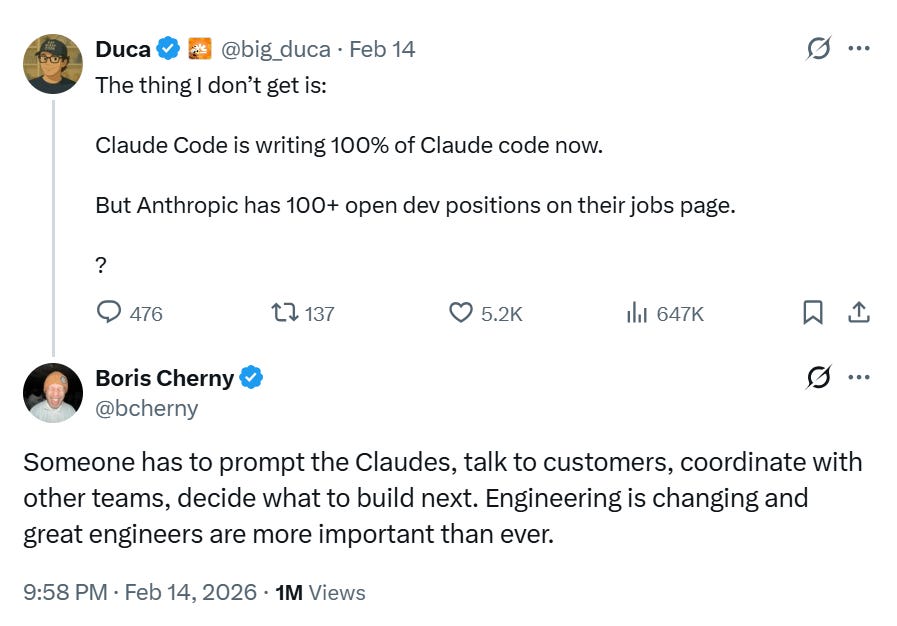
There is this common idea that with AI, we can run much leaner and that agents can replace much of the human work.
The first attack was on software engineers: for a short while, leaders claimed that the profession was dead. That turned around pretty quickly, with companies understanding they still need experienced engineers to decide what to build, review what LLMs produce, and maintain the systems afterward. Engineers now make up 55% of Big Tech hiring, up from 46% in 2019.
But with managers, it’s harder to justify, and we are repeating the flattening cycle that we went through 10 years ago. Some of the bigger tech companies started by laying off middle managers, and the smaller companies started to think, “Oh, I should consider that too” (whether their own conditions are the same or not).
And when leaders look at the first-line Engineering Manager’s role, they think: “Well, they’re close to the work. Maybe they should just be doing the work? Maybe we don’t need all of them? What value do they actually provide?”
I hear from managers all around me that the number of people reporting to them keeps increasing. Meta is saying a 1-to-50 ratio is their goal, and 15-20 engineers reporting to a manager is becoming very common.
Combine that with the expectation that EMs also ship code, and you quickly start to experience the EM’s role erosion cycle:
Less capacity. You have less capacity to actually manage people.
Less managing. So you do less of the work only you can do. You do fewer 1:1s, postpone career conversations, and don’t deal with team conflicts or processes.
Less value. Which means you provide less value to the engineers reporting to you, and they get used to managing without you.
Less needed. And the less value you provide as a manager, the less ‘needed’ the leader thinks you are. So they increase the engineer-to-manager ratio again.

And this cycle isn’t new. Tech companies get into this delusion that the ‘people stuff’ doesn’t really matter, and then they wake up and quietly start adding back layers:
We are repeating history
This trend of getting rid of managers has been tried before.
In 2002, when Google had ~300 engineers, Larry Page and Sergey Brin tried to completely remove all managers. It failed after just a couple of months:
“They relented when too many people went directly to Page with questions about expense reports, interpersonal conflicts, and other nitty-gritty issues. And as the company grew, the founders soon realized that managers contributed in many other, important ways - for instance, by communicating strategy, helping employees prioritize projects, facilitating collaboration, supporting career development, and ensuring that processes and systems aligned with company goals.”
Six years later (with 20k+ employees), Google decided to test again if managers are important. They ran Project Oxygen, which showed that managers did matter (surprise), with good managers strongly correlating with team performance and engineer satisfaction.
And now, Google is flattening again - cutting about 10% of manager, director, and VP roles.
It’s a similar story at Microsoft:
2014 - Satya Nadella announced a ‘major restructuring’: fewer management layers and wider spans of control.
2025 - 11 years later, Microsoft flattened again to ‘increase span of control’.
Layoffs and flattening are most often sudden and make the news headlines, but the recovery is less exciting. No company suddenly hires hundreds of managers, they slowly rebuild those layers over time.
But why? If companies consistently believe that managers are not needed, how come they keep hiring managers again and again?
How flattening impacts the company
You can actually run ‘flat’ for a while. It takes a few months or years before companies experience the impact and the pendulum begins to swing back.
What happens is that companies start to accumulate organizational debt - similar to tech debt, a gradual buildup of dysfunction that undermines how good work gets done.
Relational debt is the type of org debt that accumulates the fastest after a flattening. It’s strained, neglected, or transactional relationships where trust and psychological safety erode. When you expand an EM’s role to both be more technical and have more reports, something has to give - you’re chipping away at the people part of the company, and that has consequences.
There’s more negative behavior turning into toxic behavior, more conflicts, and less collaboration.
And that’s even worse with AI:
One of the things managers repeatedly ask me about in workshops is: “How do I keep the team together when they prefer to talk to AI rather than talk to each other?”
So in addition to reduced human contact between managers and employees, engineers are also less in contact with each other.
And once you remove that human connection, you start having more toxic behavior and conflict. And when that conflict occurs, leaders treat it as ‘one bad apple’. The response is often to just get rid of ‘the problematic person’. Well, that person is operating inside an environment, and that poor environment does more damage to your company goals than shipping speed ever makes up for.
Every company has its own problems. When you rip out layers of management, you basically deprioritize people - which will only magnify your existing problems and will make it much harder to deal with the massive change currently happening in the industry.
What EMs can do about it
Senior leaders are getting messages from the market right now. “You can go faster and leaner, you don’t need all those people, use AI and reach your goals faster.”
That makes them anxious, thinking: “Everyone else is doing it, why can’t we?”
The best thing an EM can do is provide grounded reality. The more information we give them, the better decisions they make, and the closer we’ll get to breaking the collective delusion a lot of us are under right now.
Here’s what I suggest to start from:
1. Write it down. Spend time capturing what the real problems are. Get it out of your head so that you can really see them.
It’ll probably not be one or two big problems, but 10-15 smaller ones. Some conflicts between engineers and the PM, engineers not working well together, etc. It’s much easier to come to your manager with a big problem. With 10 small ones, you feel like your already overloaded manager just wouldn’t care.
The next step is to help them care:
2. Attach them to something bigger.
When you’re looking at the 10 little problems, are they all different shapes? Or can you find patterns? If not, how do you convey something that looks small in a way that attaches it to something bigger?
For example, a disagreement between an engineer and the PM. No director wants to hear about that. But the PM ended up not listening to the engineer, so the team built what was asked for and threw most of it away two weeks later. Add to that two engineers who don’t work well together and shipped overlapping implementations of the same thing a week later.
How can you frame that in a way they’ll care about?
Translating the challenges you’re seeing on your teams as obstacles to business goals is always a good move. Think about what your senior leaders care about most. Start with questions like:
What are the company's top priorities?
What does your Director or VP talk about most?
What keeps them up at night?
Then map your list of problems to what your leaders care about. Pick the one that you think is most critical or endangering a current project.
Final words
Thanks Suzan for a great conversation and guest article!
To be clear, I'm not saying more management layers are always better, or that there's no benefit in simplifying the chain of command. But there's a big difference between cutting managers because managers don't matter (as many flattening companies claim), and trying to fix your own org structure.
I believe that your first- and second-line engineering managers are often the ones holding the org together. I don’t think it’s a coincidence that just a couple of months after Meta laid off 700 engineering managers, it’s now facing a serious resignation wave.

What I enjoyed reading this week
The Same Side of the Table. How to deal with meetings that include your engineers (and people from outside the team).
Lenses: Forgetting, Contributing, and "Not-doing”. Loved all the 3 quotes here.
Why Ramp built its own in-house coding agent, Inspect. An AMAZING deep dive into engineering at Ramp. Many takeaways for me there.
Get the next one in your inbox
One email a week for engineering managers. No spam, unsubscribe anytime.